
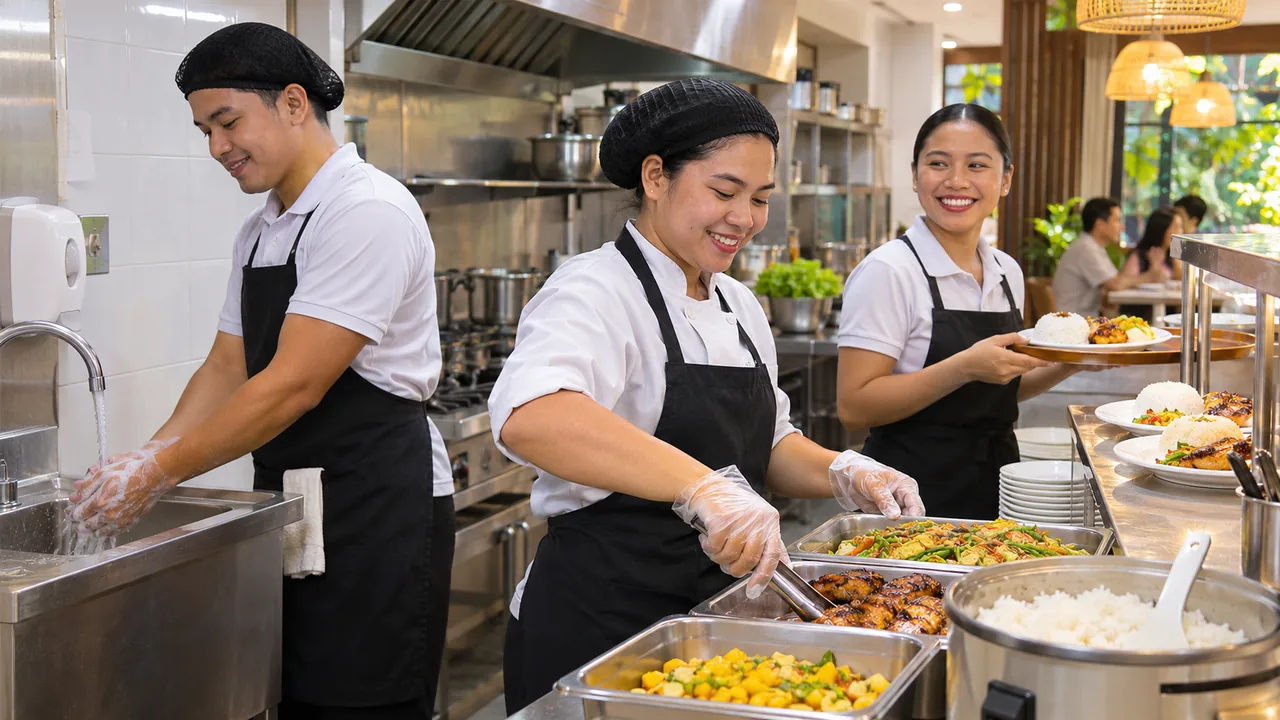
Food service headcount should follow customer flow and station workload. The best plan covers preparation, service, replenishment, sanitation, and closing without depending on constant overtime.
Forecast demand by daypart
Review transactions, orders, covers, product mix, delivery volume, promotions, weekdays, weekends, paydays, and seasonal peaks. Break the day into preparation, opening, peak service, recovery, and closing periods.
Define the station plan
Kitchen helper
Supports approved preparation, washing, portioning, staging, cleaning, and waste handling under site procedures.
Service crew or counter support
Handles customers, order flow, packing, replenishment, dining-area checks, and escalation. Cash handling should be assigned only when authorized and controlled.
Sanitation and utility support
Maintains cleaning schedules, dish flow, waste points, and service-area readiness without creating cross-contamination.
Schedule for peaks and breaks
Place trained workers at bottleneck stations before demand rises. Include setup and recovery time, not only customer-facing hours. Stagger breaks and maintain minimum safe coverage at every active station.
Screen for role fit
Confirm schedule availability, transport, communication, pace, attention to hygiene, standing requirements, and ability to follow standardized procedures. Use job-related demonstrations where appropriate and avoid assigning untrained workers to equipment or tasks.
Make site training specific
- Personal hygiene and illness reporting.
- Approved handwashing and glove practices.
- Allergen and cross-contamination controls.
- Temperature, holding, and storage procedures.
- Equipment safety and emergency response.
- Customer service and complaint escalation.
Track service and quality together
Measure wait time, order accuracy, throughput, product availability, waste, sanitation checks, customer feedback, attendance, overtime, and early turnover. Speed should never be improved by skipping hygiene or safety controls.
Plan for call-outs and surges
Cross-train approved workers across compatible stations and maintain an escalation path for sudden absences, equipment downtime, large orders, and supply delays. The business continuity guide helps structure backup coverage.
Share the complete requirement
Provide the site, shift, station, expected volume, uniform, training, health and safety requirements, transport conditions, and target date. Clear inputs improve screening and deployment speed.
Frequently asked questions
How do I calculate food service staffing?
Forecast demand by daypart, identify station workload and bottlenecks, add setup, cleaning, breaks, closing, and realistic absence coverage.
What roles can a food service staffing plan include?
Depending on the operation, roles may include kitchen helpers, service crew, counter support, packers, dishwashing support, utility staff, and coordinators.
What should day-one training cover?
Cover hygiene, illness reporting, food-safety procedures, station methods, equipment safety, customer service, emergency response, and escalation.
Which KPIs should employers track?
Track wait time, order accuracy, throughput, availability, waste, sanitation checks, attendance, overtime, customer feedback, and turnover.